Colour receptors
2 cone types (~430 & 555 nm)
3 cone types
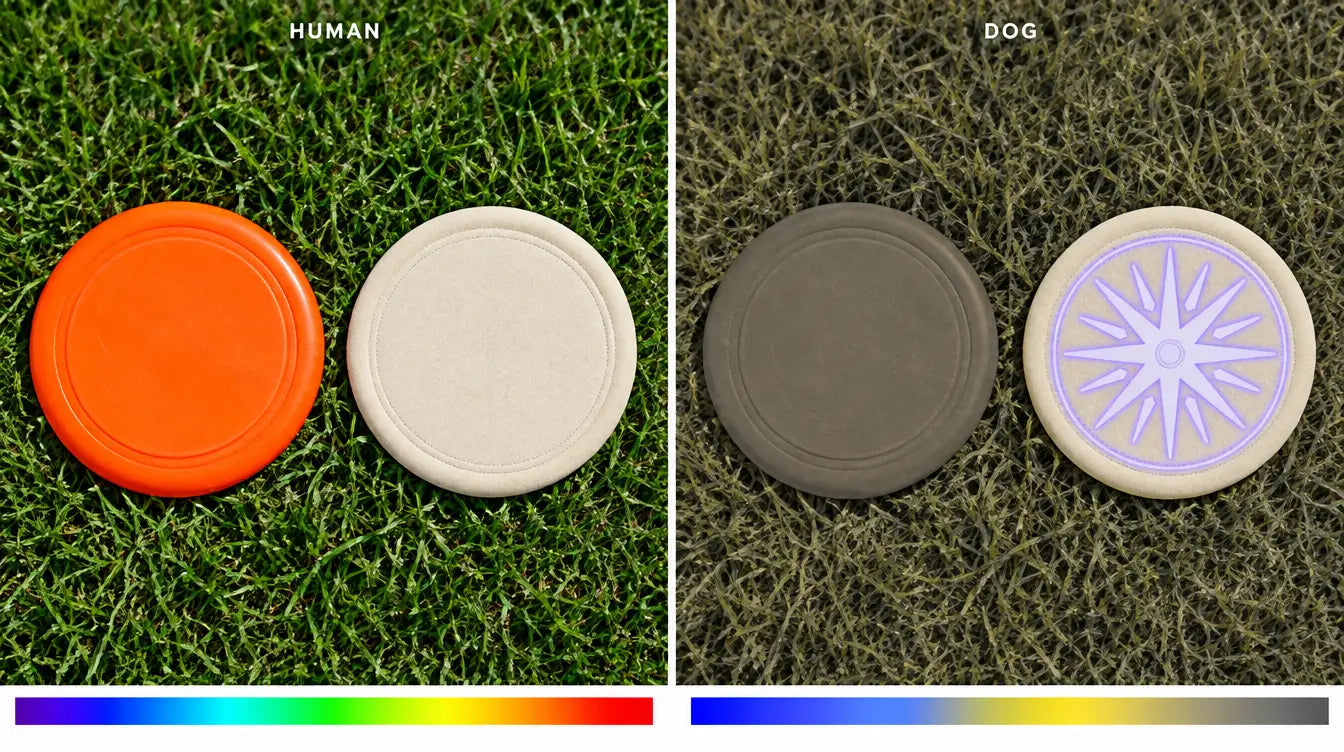
Orange on grass vanishes. Design only on the blue–yellow axis.


Research notes
Dogs see blue and yellow best; red, orange and green blur into grass. Their eye is a different instrument, built for different work: fewer colours, lower resolution, far better motion detection in low light — and a lens that lets ultraviolet through where yours shuts it out. Every design decision in GHOSTCATCHER follows from one of those differences. Here they are, with the evidence behind each and how strong that evidence actually is.
Ultraviolet
Light does not stop at violet. It continues into ultraviolet, and whether an animal can use that stretch comes down to one part: the lens. Yours absorbs it. Your dog's does not — which is the entire physical basis of our patent.
Schematic. Transmission is a curve, not a hard cut-off, and it varies with age.
Physics, then behaviour — we checked both. That ultraviolet reaches a dog's retina is measured physics. Whether a dog uses it to find a disc faster is a behavioural question, so we answered it with a behavioural test of our own: in our in-house trials, dogs found the UV-printed disc better than an unprinted one. That result is what this disc was built on.
Colour
The same five swatches, rendered for a human retina and then for a dichromatic one. Notice that orange and green arrive at nearly the same place.
Human vision three cone types
Dog vision two cone types
Read the first three swatches on the right. Orange, red and grass converge on one yellowish band. Blue and yellow stay separate and stay bright — which is the entire argument for colouring a disc on that axis.
Choosing a disc? Colour is one of five checks for a dog safe frisbee →
Six differences
Left: what you see. Right: what your dog sees. Under each pair — the design decision it forces.
Orange on grass vanishes. Design only on the blue–yellow axis.

Fine patterns are wasted. Only bold, low-frequency shapes survive.

A spinning disc reads differently in time. Spoke count matters in flight.

Motion in low light is a strength. At dusk, brightness contrast beats hue.

Depth judgement is weaker; peripheral movement is caught far sooner.

The one GHOSTCATCHER's patent is built on: a UV-reflective mark exists for the dog alone.
Illustrations are simulations built from the published figures cited below — not photographs of a dog's view.
Sources
We grade our own claims because a pet product that overstates the science is easy to write and impossible to defend. Where the answer is "not known yet", we say so.
Two cone classes with peaks near 430 nm and 555 nm. Red, orange and green are not separable.
Byosiere et al. on the Ebbinghaus–Titchener illusion: dogs are susceptible, but in the opposite direction to humans. Animal Cognition · Müller-Lyer, Learning & Behavior
Demonstrated in domestic cats and in lions used as zoo enrichment. Strong evidence for a shared retinal mechanism — but not yet tested in dogs. Bååth et al., 2014 · Frontiers in Psychology, 2019
Some dogs perceive Kanizsa-type contours as humans do; others don't. Individual variation is large. Byosiere, 2019
Douglas & Jeffery (2014) measured lens transmission directly across a range of mammals — dog, cat, ferret, hedgehog among them — and found substantial UVA passing through where the human lens absorbs it. This measurement is the physical basis of our patent. Proc. R. Soc. B, 2014
McGreevy, Grassi & Harman (2004) found nose length correlates with whether a dog carries a horizontal visual streak or a concentrated area centralis. This is the basis of our breed pages — and the reason we publish field-of-view figures by skull shape rather than by breed name.
The two things we tested ourselves. Both were run in-house before this disc went into production, and both came back the same way. First: dogs found a UV-marked disc better than an unmarked one. Second: on grass, a blue-and-yellow disc was picked out sooner than an orange one.
Both results come from our own trials, run to our own protocol — and that protocol is what this product was built on. A patent covers a method; it is not by itself evidence that the method works better, and we do not present it as one.